“Shall we have a coffee?” is probably the most common invitation in the Western Balkans. It is used to start a friendship, close a business deal, reconcile after an argument or simply pass the afternoon. The coffee itself matters, but the time spent around it matters more.
This guide explains the traditional way of making coffee in the region, the regional differences you will notice, and the habits that make the ritual what it is.
A short history
Coffee arrived in the Balkans with the Ottoman Empire, which ruled much of the peninsula for several centuries. Coffee houses spread from Istanbul into cities such as Sarajevo, Skopje, Prizren and Shkodër, where they became places for news, politics, music and games. The method of brewing, finely ground beans simmered in a small pot, stayed in use long after the empire withdrew, and each country adapted it in its own way.
Today, espresso machines are everywhere, and younger people often order a macchiato. But the traditional pot-brewed coffee remains the coffee of the home and of hospitality.
How traditional coffee is made
The equipment is simple: a small pot with a long handle, called a xhezve in Albanian or džezva in Bosnian, Serbian and Croatian, and coffee ground as fine as flour.
- Heat the water. Pour cold water into the pot, roughly one small cup per person, and bring it towards the boil. In Bosnia it is common to set aside a little of the hot water.
- Add the coffee. Take the pot off the heat and stir in about one heaped teaspoon of coffee per cup. If sugar is wanted, it is often added at this stage in Albanian and Turkish practice; in Bosnia it is usually served on the side.
- Bring up the foam. Return the pot to a low heat and let it rise slowly until a thick foam (kaimak in Bosnia, shkumë in Albanian) forms, without letting it boil over.
- Serve. Spoon a little foam into each cup, then pour. Wait a minute before drinking so the grounds settle.
Don’t stir or drink to the bottom. The fine grounds settle at the bottom of the cup. Sip slowly and stop when you reach the sludge; it is not meant to be drunk.
Regional differences
| Place | What to expect |
|---|---|
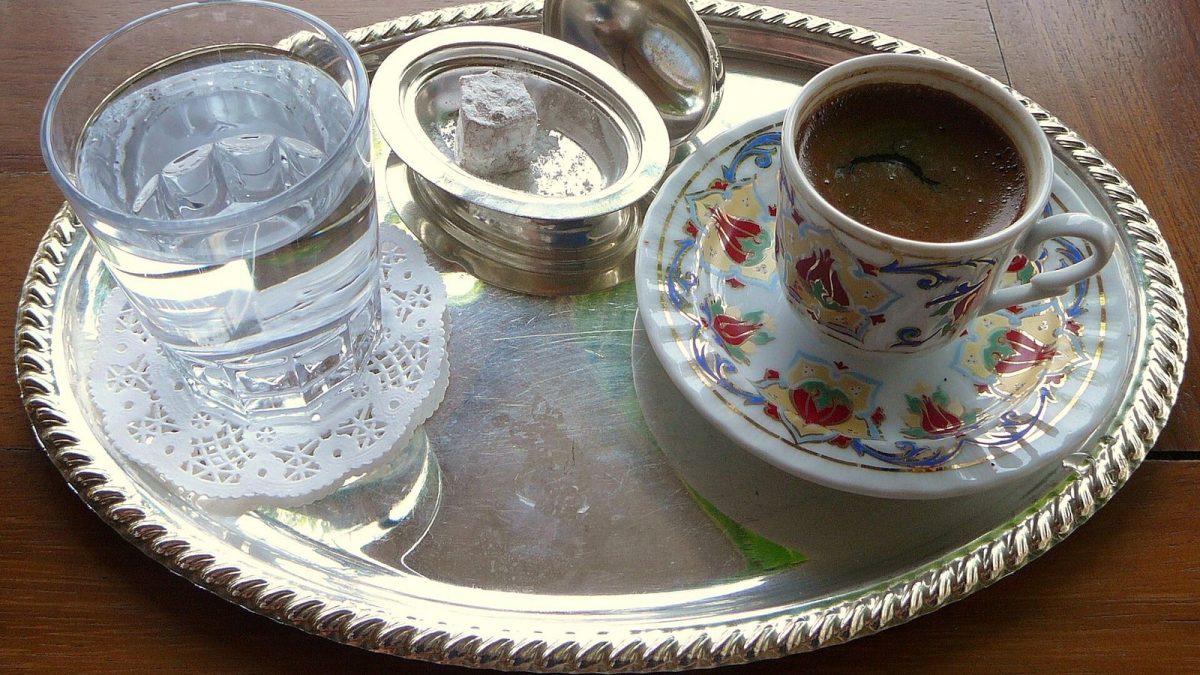
| Bosnia and Herzegovina | Served on a small metal tray with the pot, a cup without a handle (fildžan), sugar cubes and often a piece of Turkish delight (rahatlokum). Some people dip a sugar cube in the coffee and nibble it. |
| Kosovo and Albania | Often sweetened in the pot and served in small cups with a glass of water. At home, offering coffee to a guest is almost automatic. |
| Serbia and Montenegro | Called “domestic coffee” (domaća kafa); a cup is a standard part of visiting family and neighbours. |
| North Macedonia | Known as турско кафе (Turkish coffee) and popular in old bazaars, especially in the Čaršija of Skopje and in Bitola. |
The etiquette of “going for a coffee”
- Time is not counted. A coffee may take ten minutes or three hours. Waiters will not hurry you out, and asking for the bill quickly can seem abrupt.
- Somebody pays for everyone. Splitting the bill is unusual. The person who invited, or the older person, typically pays, and there may be a friendly argument about it.
- At home, accepting is polite. Refusing a coffee offered by a host can come across as cold. If you really cannot drink more, ask for a glass of water or juice instead.
- Coffee is how visits start. In many families, the coffee marks the beginning of a visit and a second round can be a gentle sign that the visit is coming to an end.
Reading the cup
In some homes, after the coffee is finished, the cup is turned upside down onto the saucer and left to cool. The patterns the grounds leave are then “read” for fun, predictions about travel, love or money. It is mostly a light-hearted game among friends, but it is a familiar scene in many households.
Where to try it
- Sarajevo’s Baščaršija: the old bazaar, where several traditional coffee houses serve coffee on copper trays.
- Prizren’s old town: cafés along the river near the Stone Bridge, with views of the fortress.
- Skopje’s Old Bazaar: small cafés among the craft shops and caravanserais.
- Any family home: the best coffee is the one you are offered within five minutes of arriving.
Wherever you drink it, the lesson is the same: in the Balkans, the coffee is the excuse, and the company is the point.
Sources and further reading: UNESCO Intangible Cultural Heritage, “Turkish coffee culture and tradition” (2013); local tourism boards of Sarajevo, Prizren and Skopje.