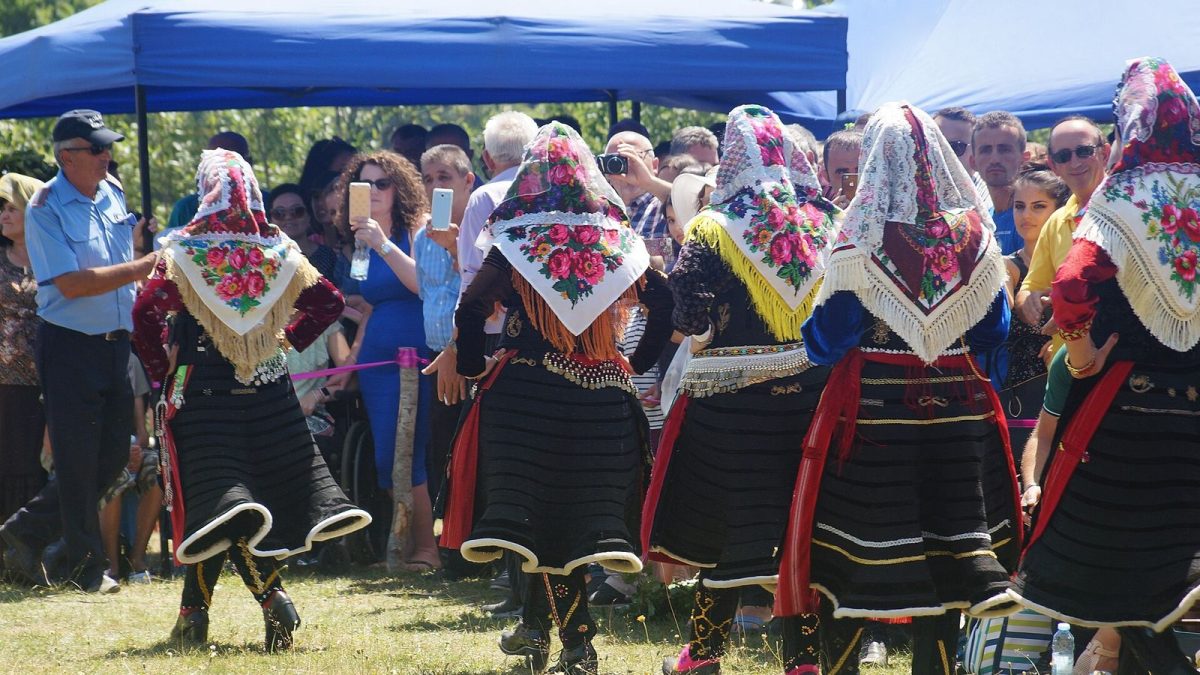
If you have seen photographs of women from the mountains of northern Albania in traditional dress, you may remember a skirt that looks almost like a bell: wide at the bottom, rigid, and moving in a slow, rhythmic sway as the wearer walks. That garment is the xhubleta. For centuries it was part of everyday and festive life in the highlands. Today very few people know how to make one.
Where it was worn
The xhubleta belongs to the mountain communities of northern Albania and neighbouring areas, including Malësia e Madhe, the Dukagjin highlands, and Albanian villages across the border in Montenegro. Each area, and sometimes each village, had its own variations in colour, decoration and the way the garment was worn with an apron, a belt, a short jacket and a headscarf.
It was the dress of married women and of brides. A woman’s xhubleta could say a great deal about her: her region, her family’s status and the stage of her life.
How it is made
The xhubleta is not woven in one piece. It is built from many long strips of thick felted wool, sewn together side by side and shaped so that the skirt flares out at the hem. The strips are usually black, with decorative bands near the bottom that can include coloured wool, cotton, silk, and sometimes metal threads or small ornaments.
Making one is slow, physical work. The wool has to be prepared, felted, cut, sewn and decorated by hand, and a finished garment can be heavy. Experienced makers know how to give it its characteristic shape so it holds its form while still moving with the body. That knowledge was traditionally passed from mother to daughter, and from one village craftswoman to the next.
A very old shape
Researchers have long been interested in the xhubleta because its bell shape resembles figures on very old artefacts from the Balkans and the Mediterranean. Some see it as one of the oldest surviving forms of women’s dress in Europe. These comparisons are debated, but they help explain why ethnographers and museum curators regard the garment as something special.
UNESCO and urgent safeguarding
In 2022, UNESCO added “Xhubleta, skills, craftsmanship and forms of usage” to its List of Intangible Cultural Heritage in Need of Urgent Safeguarding. The listing does not protect the garment as an object in a museum. It recognises the living knowledge around it: how it is made, worn and passed on.
The reason for the urgency is simple. Migration from the mountains, changes in daily life, and the time and cost of making a single xhubleta mean that only a small number of craftspeople still have the full set of skills. Without new makers, the tradition could disappear within a generation.
Where to see one
- Museums: the National Historical Museum in Tirana and regional ethnographic museums in the north hold examples.
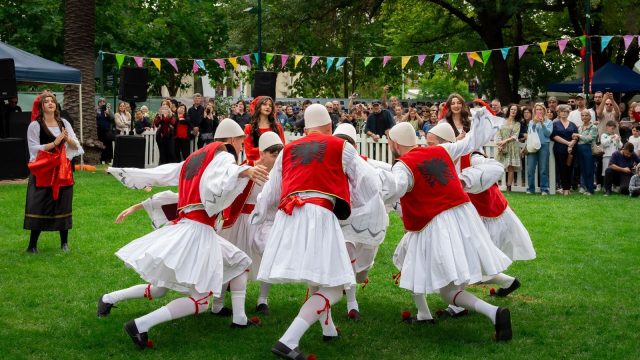
- Festivals: folklore festivals and village celebrations in the highlands sometimes feature women wearing the xhubleta.
- Weddings: in some families, the xhubleta still appears at weddings, either worn by the bride or by older relatives.
- Workshops: cultural organisations have run training projects to teach younger women the craft. These are the best hope for its future.
Why it matters
The xhubleta is more than a costume. It carries the story of how mountain communities lived, worked and celebrated, and of the women who held much of that knowledge. If you see one in a museum, take a moment to look at the stitching and imagine the hours behind it. If you meet someone who still makes them, you have met one of the last keepers of a very old tradition.