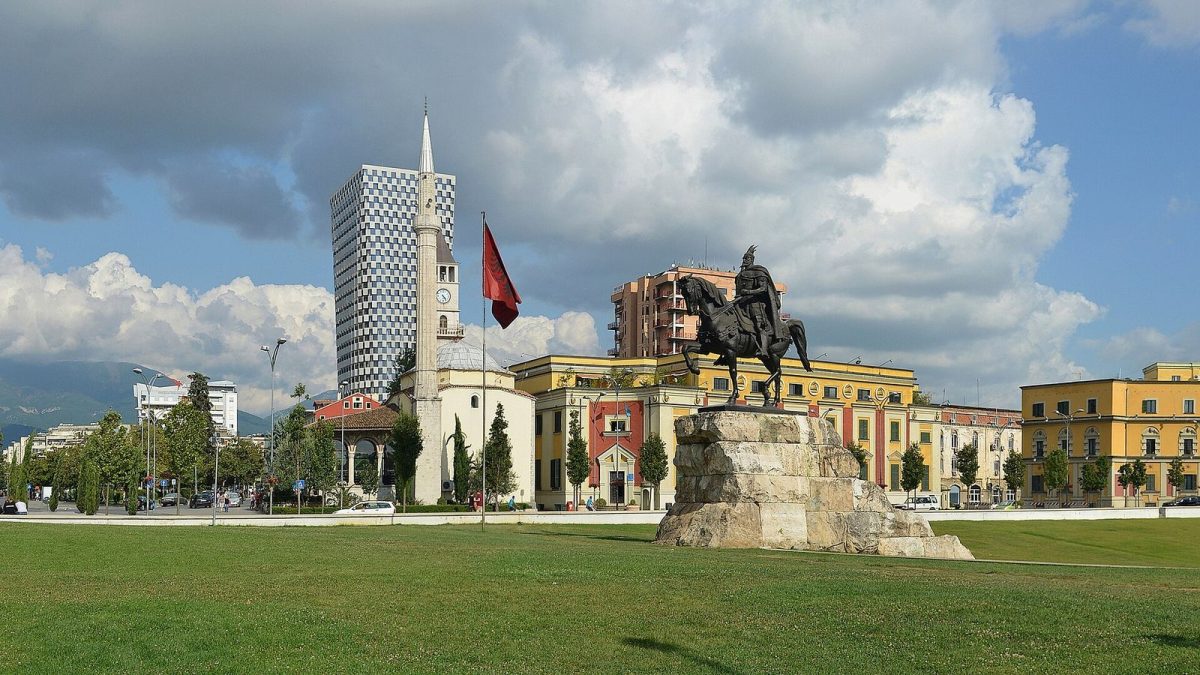
In almost every Albanian town there is a square, a street or a school named after Skanderbeg. His equestrian statue stands at the heart of Tirana, his portrait hangs in homes and offices, and his story is taught to every Albanian child. Yet many visitors to the region know little about who he actually was. This guide explains the essentials.
From hostage to Ottoman commander
Gjergj Kastrioti was born in 1405 into the Kastrioti family, a noble house that ruled lands in what is now northern and central Albania. At the time, the Ottoman Empire was expanding across the Balkans, and local lords often had to accept Ottoman overlordship. As was common practice, the young Gjergj was sent to the Ottoman court as a hostage to guarantee his father’s loyalty.
There he was converted to Islam, educated in the Ottoman military system and rose to become a capable commander. He received the name Iskender: Alexander, after Alexander the Great, and the title bey, a rank of lord. Combined, these gave the name by which he is remembered: Skanderbeg.
The break with the Sultan
In 1443, during a battle near Niš against a Christian army led by the Hungarian commander John Hunyadi, Skanderbeg abandoned the Ottoman side with a group of Albanian soldiers. He rode to Krujë, the fortress town of his family, took control of it and raised his own flag. According to tradition he declared that he had not brought freedom to his people but found it among them.
He returned to Christianity and set about building a coalition strong enough to resist the empire he had once served.
The League of Lezhë
In March 1444, Skanderbeg gathered Albanian noble families in the town of Lezhë. The resulting alliance, known as the League of Lezhë, brought together rival clans under his military leadership. Historians often describe it as the first time Albanian lords united in a common political and military framework, which is why it is seen as a founding moment of Albanian statehood.
Twenty-five years of resistance
For the next quarter of a century, Skanderbeg defended his territories against repeated Ottoman campaigns, including large expeditions led personally by Sultan Murad II and later by Sultan Mehmed II, the conqueror of Constantinople. His strategy relied on:
- Mobility. Small, fast forces that used the mountains to ambush much larger armies.
- Fortresses. Krujë in particular withstood several sieges.
- Alliances. He sought support from Venice, the Kingdom of Naples and the Papacy, and at one point sent troops to Italy to help his ally King Alfonso of Naples.
The sieges of Krujë became legendary. The fortress held out against major Ottoman attacks in 1450 and again in later campaigns, and Skanderbeg’s reputation spread across Europe. Popes praised him as a defender of Christendom.
Death and what followed
Skanderbeg died of illness, usually described as malaria, in Lezhë on 17 January 1468. Without him, the resistance weakened. Krujë fell to the Ottomans in 1478, and within a few decades most Albanian lands were under Ottoman rule, which lasted until the early twentieth century.
Ottoman soldiers who later opened his grave in Lezhë are said to have taken pieces of his bones as amulets, believing they would bring courage. Today the site in Lezhë is a memorial.
Skanderbeg as a national symbol
During the Albanian national awakening of the nineteenth century, writers and activists turned to Skanderbeg as the symbol of a shared Albanian identity that crossed religious lines ; Muslim, Orthodox and Catholic Albanians could all claim him. When Albania declared independence in Vlorë in 1912, the flag raised was the red banner with the black double-headed eagle associated with him.
Where to see his legacy: the Skanderbeg Museum inside Krujë Castle, about 30 km from Tirana; Skanderbeg Square in central Tirana; and his memorial in Lezhë. Copies of his famous goat-head helmet and sword are displayed in Albania, the originals are held in the Kunsthistorisches Museum in Vienna.
Skanderbeg beyond Albania
Statues of Skanderbeg stand in Pristina, Skopje, Rome, Brussels and other cities with Albanian communities. He also appears in European art and music: the eighteenth-century French composers François Francœur and François Rebel wrote an opera called Scanderberg, and the Italo-Albanian (Arbëresh) communities of southern Italy, descended partly from Albanians who left after his death, preserve his memory in songs and festivals.
Myth and history
As with any national hero, Skanderbeg’s story mixes history and legend. Much of what we know comes from a biography written by Marin Barleti, a priest from Shkodër, in the early sixteenth century, which was influential but also heroic in tone. Modern historians use Venetian, Ottoman and papal records to build a more balanced picture. What is not in doubt is the scale of his achievement: a small, divided region held off one of the most powerful empires of its time for twenty-five years.
Sources and further reading: Marin Barleti, The History of the Life and Deeds of Scanderbeg; Oliver Jens Schmitt, Skanderbeg: Der neue Alexander auf dem Balkan; National Historical Museum, Tirana; Kunsthistorisches Museum Vienna collection notes.