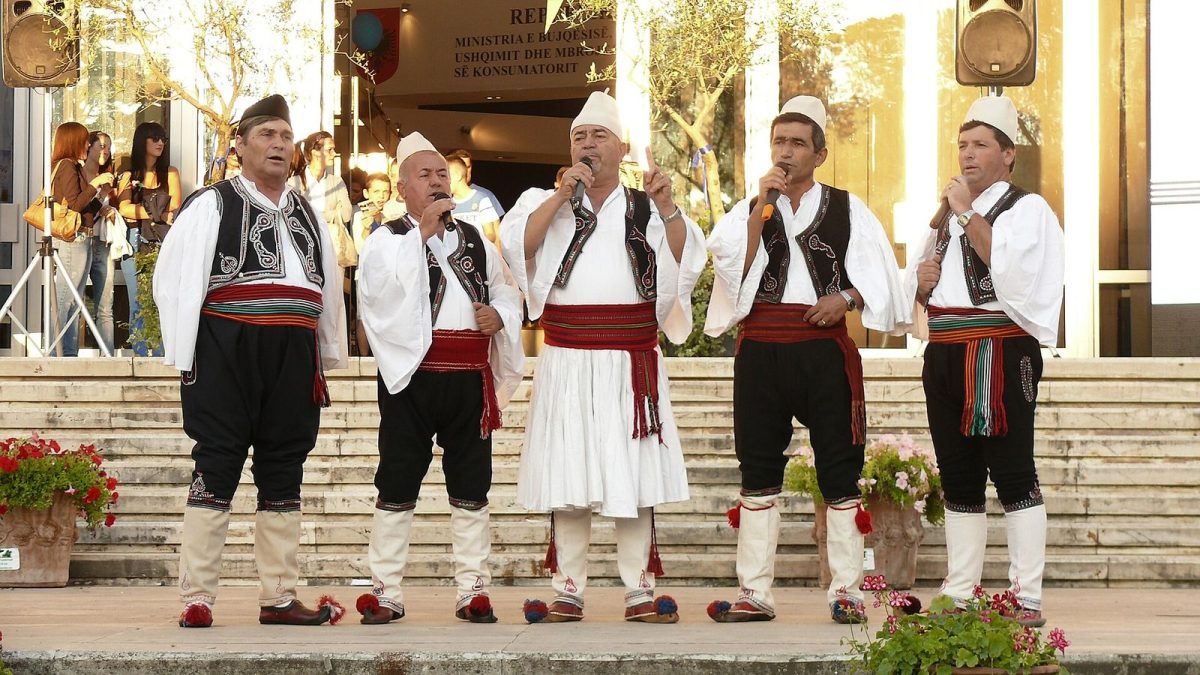
The first time you hear Albanian iso-polyphony it can sound almost ancient and almost modern at the same time. Two or three soloists trade phrases above a steady, humming drone held by a group of men or women. The harmonies rub against each other in ways that Western classical music would avoid, and the effect is powerful, raw and very human.
This guide is a short introduction for listeners: how the music is built, how the regional styles differ, and where to experience it properly.
What “iso” means
The word iso refers to the drone, a sustained note, usually sung on a vowel, that continues under the song. It is related to the drone used in Byzantine church chant, which has the same name. In Albanian folk practice, the iso is typically sung by a group, while individual singers take the melodic parts.
A common way to describe the structure is by roles:
- The “taker” (marrës): the singer who begins the song and leads the main melody.
- The “turner” or “cutter” (kthyes / prerës): a second voice that answers, crosses or ornaments the first.
- The “thrower” (hedhës): in some traditions, a voice that adds high, often yodel-like, interjections.
- The iso group: everyone else, holding the drone that anchors the piece.
The exact terms vary from village to village, but the principle is the same: a small number of voices weave around each other on top of a constant foundation.
Regional styles
Specialists generally divide southern Albanian polyphony into two broad families, with further local variations.
Tosk polyphony
In the Tosk tradition, the drone is often continuous and smooth. Songs tend to flow in a more lyrical, legato manner, and the iso may be sung on a sustained vowel that barely changes.
Lab polyphony
The Lab region (roughly the mountainous south-west, including areas around Vlorë, Tepelenë and Gjirokastër) is known for the most complex style. Lab songs can have three or four distinct parts, and the drone may be rhythmic rather than continuous. The texture is denser, and the dissonances are sharper.
Çam polyphony
Çam songs, associated with the Albanian community originally from the Çamëria region, have their own characteristic ornamentation and are often performed by ensembles that preserve this repertoire.
What the songs are about
Iso-polyphonic songs cover the whole range of community life. There are wedding songs and love songs, lullabies, songs of exile and migration (kurbet), historical songs about rebellions and heroes, and laments sung at funerals. Many are performed at weddings and family celebrations, where singing is part of how a community marks important moments.
Because the tradition is oral, songs are learned by ear and change slightly with every generation and every village. Two groups singing the “same” song may produce quite different versions.
UNESCO recognition
In 2005, UNESCO proclaimed Albanian folk iso-polyphony a Masterpiece of the Oral and Intangible Heritage of Humanity. When UNESCO’s Representative List of the Intangible Cultural Heritage of Humanity was created, the tradition was incorporated into it in 2008. The recognition highlighted both the artistic value of the music and the risks it faces: emigration from rural villages, urbanisation and the ageing of experienced singers.
Since then, cultural organisations, festivals and local ensembles have worked to document songs, record older performers and teach younger singers.
How to hear it live
- Gjirokastër National Folklore Festival. Held periodically in the castle of Gjirokastër, this is the country’s most important showcase of folk music and dance, with groups from across Albania and Albanian communities abroad.
- Village festivities. Summer weddings and saints’ day celebrations in the south are where the music lives most naturally, but remember that these are private family events, so only attend if invited.
- Concerts and ensembles. Several professional and amateur ensembles perform at cultural centres in Tirana and in cities of the south, and some tour abroad.
- Recordings. Archival field recordings and modern albums are widely available on streaming platforms; searching for “Albanian iso-polyphony” or the names of Lab and Tosk ensembles is a good start.
Listening tip: try focusing only on the drone for the first minute. Once your ear settles on it, switch attention to the two lead voices and notice how they deliberately clash and resolve against that steady base. The tension is the point.
Why it matters
Iso-polyphony is more than a musical technique. It reflects a way of making music collectively, where the group’s sustained voice supports the individual and where songs carry local history from one generation to the next. Listening to it is one of the most direct ways to understand the culture of southern Albania, and it is an experience that tends to stay with people long after they leave.
Sources and further reading: UNESCO Intangible Cultural Heritage, “Albanian folk iso-polyphony” (ich.unesco.org); Albanian Ministry of Culture materials on the National Folklore Festival of Gjirokastër.