Lake Ohrid is deep, clear and very old. Its waters are home to species found nowhere else on Earth, and its shores have been settled since antiquity. Today it is one of the most rewarding destinations in the Balkans: a mix of medieval churches, beaches, fish restaurants and slow evenings by the water.
- Shared by: North Macedonia (about two-thirds) and Albania.
- Age: scientists estimate the lake is more than one million years old, making it one of the oldest in the world.
- UNESCO: listed since 1979–1980 on the Macedonian side; extended to include the Albanian side in 2019.
- Main towns: Ohrid and Struga (North Macedonia), Pogradec (Albania).
Why the lake is special
Ohrid is a tectonic lake fed largely by underground springs, including water filtering through the mountains from neighbouring Lake Prespa. That helps explain its clarity. Because it has existed for so long, it has developed a high number of endemic species, including the Ohrid trout. UNESCO recognises the region for both its natural and its cultural value.
Please note: the Ohrid trout (letnica) is protected, and fishing it has been restricted. If you see it on a menu, ask where it comes from, or choose another local fish instead.
Ohrid town
The town of Ohrid in North Macedonia is the lake’s cultural capital. Its old town climbs a hill above the harbour, crowned by a fortress.
- Church of St John at Kaneo. A small thirteenth-century church on a cliff over the water, the lake’s most famous view.
- Plaošnik and St Clement and Panteleimon. A site associated with Saint Clement of Ohrid, a medieval scholar linked to the early spread of Slavic literacy; the church has been rebuilt on its original foundations.
- Samuel’s Fortress. Walls and towers with panoramic views over the town and lake.
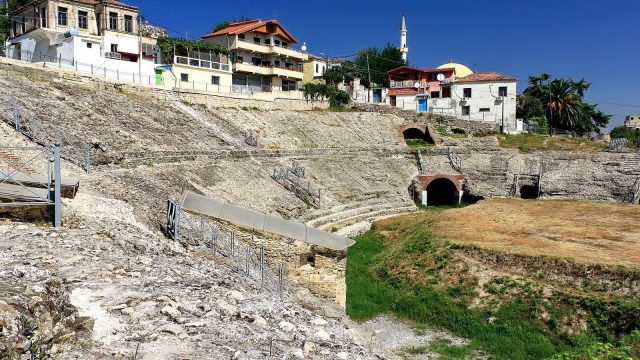
- The Ancient Theatre. A Hellenistic-era theatre still used for summer performances.
- Church of St Sophia. A large medieval church with important frescoes, also used for concerts.
Ohrid’s summer festival brings music and theatre performances to these historic venues.
Around the Macedonian shore
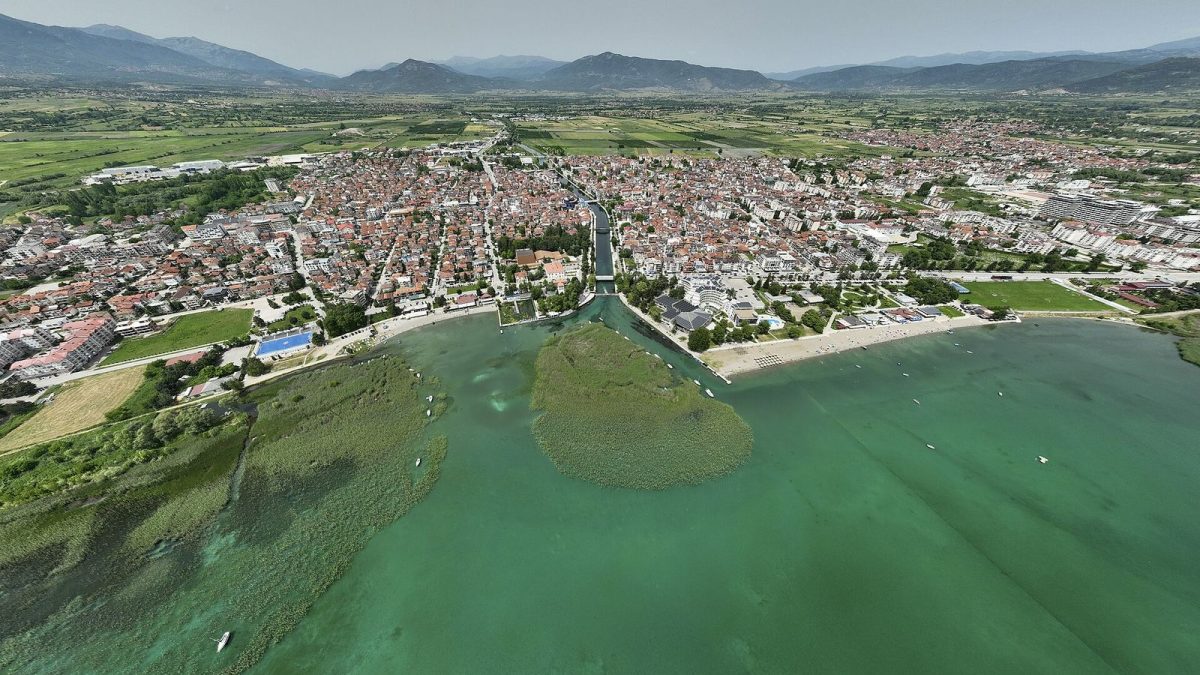
- Struga: at the lake’s northern end, where the Black Drin river flows out. Known for its Poetry Evenings festival.
- Bay of Bones: a reconstructed prehistoric pile-dwelling settlement on wooden platforms over the water.
- Monastery of St Naum: at the southern tip near the Albanian border, beside springs where you can take a small rowing boat through clear channels.
- Galičica National Park: mountains between Ohrid and Prespa with viewpoints over both lakes.
The Albanian shore: Pogradec and around
Pogradec is a relaxed lakeside town with a long promenade, popular with Albanian holidaymakers. Nearby, the villages of Lin (with the remains of an early Christian church and mosaics) and Tushemisht (with springs and small canals) are worth a visit. The Albanian side is generally quieter and cheaper, with fish restaurants and simple guesthouses right on the water.
Crossing between the two countries
The main border crossing on the lake is at Sveti Naum–Tushemisht, near the Monastery of St Naum, linking Ohrid and Pogradec by road in under an hour. Another crossing at Qafë Thanë–Kafasan lies on the north-western side, on the route between Struga and Elbasan. Check current documentation requirements for your passport before travelling.
Swimming and beaches
The water is clean and cool, and beaches are mostly pebbly with wooden piers. Popular spots on the Macedonian side include the beaches south of Ohrid towards St Naum; on the Albanian side, the stretch around Pogradec and Lin. The swimming season is roughly June to September.
Suggested itinerary
- Day 1: Ohrid old town, Kaneo at sunset, dinner by the harbour.
- Day 2: south along the shore to Bay of Bones and St Naum; boat on the springs.
- Day 3: cross to Pogradec, visit Lin and Tushemisht, swim on the Albanian side.
Practical information
- Currencies: Macedonian denar in North Macedonia, Albanian lek in Albania; euros are often accepted in tourist places but not everywhere.
- Getting there: Ohrid has an international airport; Skopje is about three hours by road, Tirana about three hours to Pogradec.
- When to go: June and September offer warm water without the peak-summer crowds.
Lake Ohrid rewards those who take it slowly, a swim in the morning, a church in the afternoon, and fish by the water as the light fades over the mountains of the opposite shore.
Sources and further reading: UNESCO World Heritage Centre, “Natural and Cultural Heritage of the Ohrid region”; Galičica National Park; tourism information of Ohrid and Pogradec municipalities.